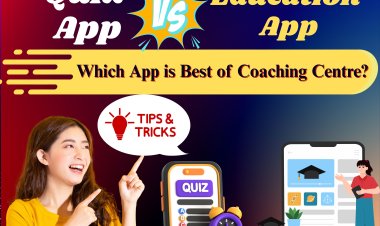



which platform is best for online Education Business - App vs Website.
When it comes to building an online education business, the choice between an app and a website (or a combination of both) is crucial and depends heavily on your target audience, content type, and business goals. There's no single "best" platform, as each has distinct advantages and disadvantages.
 Mera Template




App vs Website: Which Platform Grows Your Online Education Business Faster?
This is one of the greatest questions you will have to ask when starting an online education business: which platform to invest in first, mobile app or a site? Both ways have got unique advantages and more often than not, the choice lies with your audience, desired objectives, and expansion plan.
Websites are usually cheaper to develop and more convenient to maximize. They provide a wide range of accessibility-students may log in using any device through which internet is accessible and there is no need to download. SEO (search engine optimization) can also be performed on websites and bring organic traffic to your websites in the form of blog posts, landing pages, keyword searches.
As a business, websites form a good ground. You will be able to combine learning management systems (LMS), sell directly and use analytics tools to monitor the behavior of users. Usually, they are also cheaper to create than custom apps in the first place.

Nevertheless, education applications provide a better experience with mobile-first users. Living in a world where education is mobile, apps boost connectivity with students via push notifications, offline reading, gamification and quicker load time. They are built to be interactive and as such, they enable ideal microlearning sessions, quiz, and personalized learning paths.
Brand loyalty is also created by apps. A student will download your app, and be more inclined to visit and remain to be in contact with you. And to discover, you get worldwide access to distribution with app stores.
Which one then grows your business faster? The solution to this is in the knowledge about your target users:
A website is an excellent idea to begin with in case you have a majority of desktop learners or professionals who access the portal during breaks at work.
A faster adoption may be achieved by using an app in case your market involves younger learners, mobile-first (such as Gen Z of emerging markets).
What would be the most effective course? A mixed solution. Start with a responsive website and validate your idea, develop the content and gather traction. But as your viewers increase invest in a dedicated app to increase engagement and retention.

What Your Students Really Want: Learning on Apps vs. Websites
Modern learners are more spoiled of choice than ever before, but the question is, which one of the two (applications or websites) do they like better? In order to expand in the field of online education, it is vital to determine the way in which your learners access learning material through various platforms.
Websites are flexible. The access to courses is possible through any browser in laptops, tablets, or desktops. They are the best when you have intense learning that requires much concentration, e.g. when writing an essay, when using webinars, or when you are listening to lengthy lecture videos. Websites also individualize more people that do not have high-end smartphones or sufficient storage space to download another application.
As a student, sites are fantastic to do a multi-tasking. It can be convenient to change tabs and take notes and keep track of assignments on a large screen. And there is no need to update the web pages or to occupy memory space-only good internet connection.
Apps, however, excel concerning simplicity, fast speed, and interactive one-on-one interaction. As mobile-first learning is becoming more and more popular, the learners expect to be able to study and learn anywhere, anytime during their comm Utah, lunchtime, or queues. Apps made this possible through easy-to-use interface, offline sync, and push notifications that remind them of what they need to focus on.
Gamified learning, too, of course, badges, points, streaks, is also supported by an app, and this, at least with younger learners, can be highly motivating. Individualized suggestions, progress monitoring and daily reminders of learning build a more involved and regular loop of habits.
The thing is, students want their lifestyle and way of learning to be supported by that platform. Structured learning is also commonly desired by the professionals to be based on desktop-friendly websites. Learners, be it students or hobby, are biased to be casual and user-friendly with the mobile applications.
Nevertheless, the optimal learning experiences incorporate both. Having an in-depth web-based learning service and and app to have access to it faster, get a review or do a lesson makes learning effortless and precise.
The Smart Startup Guide: Should Your Education Business Launch as an App or Website?
Opening up an online education offers business opportunities, yet one of the initial and most serious choices you will have is whether to increasingly become a mobile application or a web-based organization. The decision will define anything you can think of such as user experience and marketing strategy. How then do you make the right choice on what is smarter between the two routes taken by your startup?
So, let us start with the site.
A launch built on a website can prove to be the most cost-efficient and most flexible option especially when the education startup is still at the early stages. It is easier and quicker to build a website, even through their platforms such as wordpress, kajabi, teachable, or thinkific. They also give good accessibility- students need not download anything to log in anywhere using any browser. It is also possible to use SEO to generate organic traffic, plan landing pages on various courses, and monitor analytics to see how users behave.
Startups that want to specialized in webinars, course material, learning through blogs, or even long-form education should use websites. They are compatible with desktop and mobile users (particularly, when optimized to run in a mobile environment), and they can be updated quickly and they can scale back-end tools.

However, how about the education app launch?
In case your audience is mostly mobile-first, having an app will make a fantastic launch tool. Still, apps provide outstanding user engagement, which is backed by push notifications, gamified tracking of progress, and offline capabilities. Applications are convenient and consistent to users who wish to study in micro-sessions throughout the day, on a bus, during lunch, or between classes.
Apps are also useful in brand loyalty. When the user installs your application, there are high possibilities that he/she can visit again and use it frequently. A good app is time-consuming, however, money and technical expertise are needed. There must be approval of app stores, and this is where it would find it difficult to compete, which depends highly on app store optimization (ASO) instead of SEO.
My Contact Number is +91 95187 40169